Students, Too, Sit at Langston Hughes' Table
Using Hughes’s classic poem to cultivate student culture, choice, voice and agency

We live in emotionally charged political, social and community times. As teachers teaching academic skills to empower our students to participate as citizens, community members and culturally proud Americans, it is essential to involve our students in expressing their cultural identities and defining themselves as current young citizens.
For me as a lifelong reader, lover of poetry and poetry writer, the quickest and surest way to tap my own voice, choice, agency and cultural identity has always been by recalling a poem that powerfully "opened" my own emotions, connections and reflections. One such poem stands out, Langston Hughes' "I, Too."
I, Too
By Langston Hughes
I, too, sing America.
I am the darker brother.
They send me to eat in the kitchen
When company comes,
But I laugh,
And eat well,
And grow strong.
Tomorrow,
I'll be at the table
When company comes.
Nobody'll dare
Say to me,
"Eat in the kitchen,"
Then.
Besides,
They’ll see how beautiful I am
And be ashamed—
I, too, am America.
Download an "I, Too" printable.
"I, Too" Summary and Classroom Benefit
Langston Hughes details his plight as an African American looked down upon at the spread table of American Caucasian success. And while the poem is a century old, students' experience at tables in their school cafeteria gives them a powerful and tangible connection to a place where they experience disdain, bullying, deliberate snobs, hurtful comments, scathing glances or explicit physical attacks.
Hughes continues in his poem to depict a protagonist who eats in the kitchen and not at the dining room table, but reacts with laughter and eats heartily. Instead of humiliation and defeat by societal exclusion, and rather than responding with shame or defeat, the speaker laughs, eats well, and grows strong.
This response reframes exclusion as a moment of resilience and self-preservation. The speaker's joy and nourishment symbolize inner growth and strength, showing that oppression does not diminish him—it prepares him. Hughes emphasizes that dignity and self-worth can exist even in unjust circumstances.
In the same way that Hughes' well-fed, laughing protagonist manifests his own agency, we can use this poem for activities that celebrate our student's own resilience in the face of adversity.
K-2: Today and Tomorrow's Table
Post the poem where students can see the words and read it aloud pointing at each word. Ask students to name the feelings they have when hearing the poem (sad, left out, hopeful, proud) and write their words on an anchor chart.
In order to help young learners visualize inclusion/exclusion, provide a large piece of butcher or chart paper with a rectangle in the middle where they can draw on it. Have students add things they don't have to the table. Have them draw themselves away from the table. Discuss how this feels.
Repeat this process with another piece of paper with a rectangle. This time, ask students to add things to the table that show things they do have (favorite foods, clothing, or hobbies) or want to have. Have them draw themselves at the table.
As you talk about their better table, be sure to help them celebrate the things they have and as well as dream of things that will be there in the future.
3-5: Give a Seat at the Table
Print the poem for each student and ask them to read it silently. Then, read it aloud together as a chorus. Ask students what the kitchen and table might represent.
In order to help students at this age move from personal experience to metaphorical thinking, empathy, and civic awareness,
Have students individually reflect on "What makes me belong at the table?" (culture, language, interests, or traditions). If they are willing, have students share their responses with the class
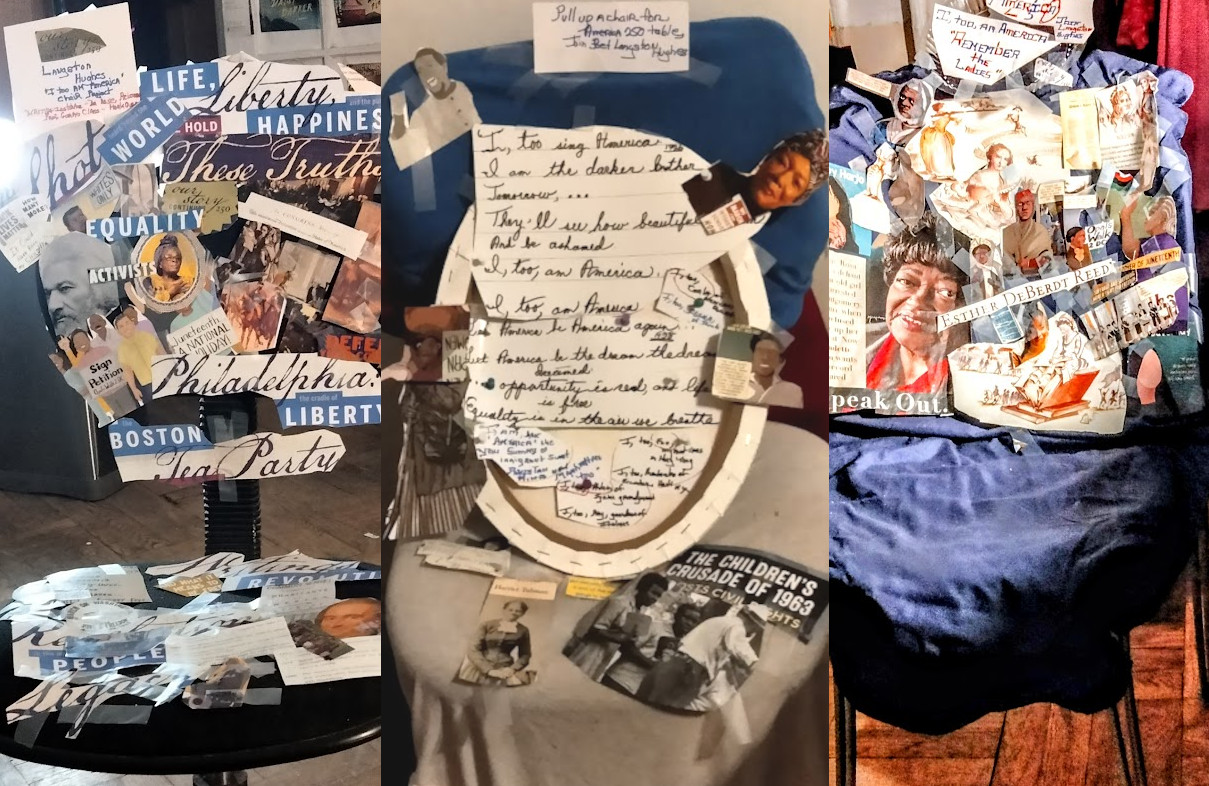
Challenge the class to come up with ideas to give everyone "a seat at the table" in your classroom. You might ask them to share their solutions in the form of cartoons and comics, or even produce a podcast.
6-8: I, Too Remix
Print the poem for each student and ask them to read it silently. Ask students to write examples of exclusion experiences on post it notes or index cards so they can share anonymously. You might also ask a parent or community member to share a personal story of exclusion tied to culture, language, or migration.
Next, revisit the poem's "tomorrow" and work together to brainstorm visions of hope and inclusion at school, in their community, or globally.
To give students at this age an opportunity to analyze power, identity, and history, while still benefiting from creative expression and choice, ask them to remix the ideas in "I, Too" for 2026. Students could remix as:
- spoken-word poetry or rap
- podcast discussion
- visual art or stage set
- animation or video
- public service announcement
Like Hughes' poem, the products, presentations or services students choose put a positive twist to the table exclusion narrative. So bring a dish, a story or a hope that is your choice. That too, is America.




 Most Read