Build Early Literacy Skills
Engage new readers and writers with creative technologies

The National Early Literacy Panel’s report on the Five Elements of a Successful Reading Program included phonemic awareness, phonics, fluency, vocabulary, and comprehension. A combination of activities and open-ended project work in creative digital tools, such as Wixie, can help you assess basic literacy skills as well as engage students in the practice necessary to build these skills.
Alphabetic Principle
You can use a variety of activities to help readers learn that speech can be segmented into small sounds (phonemic awareness) and that the segmented units of speech can be represented by printed forms (phonics). Wixie includes an Alphabetic Principle folder that includes activities like Initial Sounds, ABC Word Order, and Vowel Sounds which require students to identify initial sounds in a word or categorize them by initial or medial sounds.
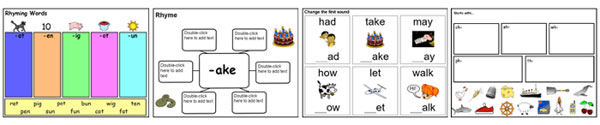
Activities are great for practice and assessing student understanding, but they aren’t motivating for many students. You can give students more voice and choice in their work, even at this young stage, by developing alphabet projects that start from a blank screen.
Most students have seen and read a book with an ABC structure and are eager to be authors on their own. Your students can add images to represents words that begin with this letter sound and then type the words and read them into a microphone.
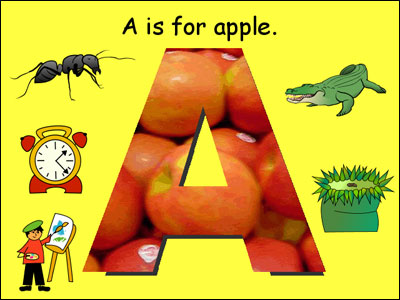
You might decide to complete a project like this a number of ways. You could build each page as your class explores new letters (and letter sounds) using an interactive whiteboard for whole class discussion. You might start a page at a center in your classroom and give students time to find and add images that begin with this letter and then complete as a class. Depending on your access to technology and the experience of your students, you could assign a different letter to each student based on their abilities.
Strengthen these same skills for older students through writing projects that incorporate rhyming words or alliteration. Julie McCoy and Jan Tell of Grand Island, Nebraska had students write an alliterative sentence for each letter of the alphabet, use paint tools illustrate it, and then combined the pages into an animated class movie.
Fluency
When students develop the ability to read text quickly and accurately, they can more rapidly comprehend what they are reading. Pre-record your voice reading a text selection in a Pixie or Wixie project so students can listen to a model of fluency. Then, have them practice reading the passage and create their own recording. Students can use playback features to listen to what they have recorded, practice the passage again, and record a final version of the passage.
When students record text they have written, they provide a demonstration of their current fluency ability. Recording, listening, and rerecording also provides an opportunity for practice without the worry about reading aloud in front of their peers, providing them with the unintimidating practice they need to become successful readers.
Vocabulary
Activities on topics like synonyms and antonyms or prefixes and suffixes provide opportunities to build vocabulary skills. Cloze Activities can help students learn to use word context clues sentence structure to develop understanding of new words. Use ABC-style books, like those mentioned above, not to address letter sounds, but new terminology within a particular topic such as transportation or biomes.
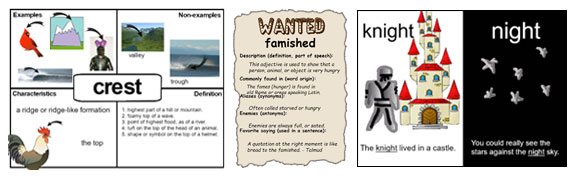
When a vocabulary word is associated with something you can visualize, it is easier to remember. Creating visual vocabulary words helps students more quickly connect a word with its meaning. The effectiveness of this approach is consistent with the findings of Robert Marzano and his team whose research shows that “the more we use both systems of representation – linguistic and nonlinguistic – the better we are able to think about and recall knowledge.”
Great literature can also help you support vocabulary acquisition, especially if you have students develop their own versions of a book they have read. After reading Judi Barrett’s Things That Are Most in the World, 2nd-grade students in Miss Alia’s class at Woodward Academy wanted to create their own book. As a class, they brainstormed all of the superlatives they could think of. Then, each student chose their favorite and wrote a sentence that provided a context clue to the meaning of the word. They used Pixie to type the sentence, draw their own illustrations and record a reading. All student pages were then combined into one class book.
Comprehension
Students are often asked to complete activity worksheets that ask them to identify key details like character, setting, and events, or describe a main character using a character traits organizer. These are great ways to begin the process and for you to evaluate student comprehension, but they aren’t exactly engaging for students or examples of authentic practice.
Rather than asking students to tell you what they know, ask them to show you what they know. This can be as simple as retelling a story, creating a condensed version that provides a textual summary of the beginning, middle, and end along with supporting illustrations. If students add a title page these summaries, creating a 4-page project, they can easily publish that work from Pixie or Wixie as a 4-panel comic or booklet they can fold and read. They could also combine analytical and creative thinking skills to design new book covers that demonstrate understanding of events and key details.
You can also make student work on comprehension skills more authentic by expanding the audience for their work. Rather than turning in a book report or summary that only the teacher sees, ask students to write a book review that will also be shared in the school library to help other students find books they will enjoy reading.
A review should not only demonstrate understanding of character, setting, and events, but be written with the intent to inform and persuade others to read, important skills in the Common Core standards. Older students can also persuade through the creation of video trailers that persuade others to read in the style of the movie trailers they watch before heading to the theater.
Creative digital tools not only help you assess literacy skills, but provide a powerful platform for students to practice and apply these skills in ways that give them a voice and ownership of the learning process.

Melinda Kolk is the Editor of Creative Educator and the author of Teaching with Clay Animation. She has been helping educators implement project-based learning and creative technologies like clay animation into classroom teaching and learning for the past 15 years.



 Most Read