Write a Great Authentic Task
Great authentic tasks incorporate collaboration, real-world problems, community connections, and self-directed learning.
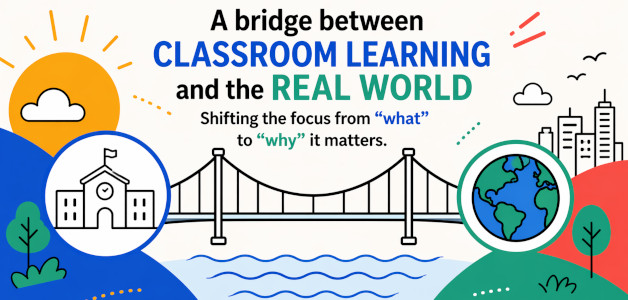
Project-based Learning engages students in projects that allow them to construct their own knowledge and develop authentic products while dealing with real-world issues. In order to challenge students on this level, it is helpful to frame their work with an authentic task.
Authentic tasks require students to demonstrate proficiency by applying existing knowledge to solve a real-world problem.
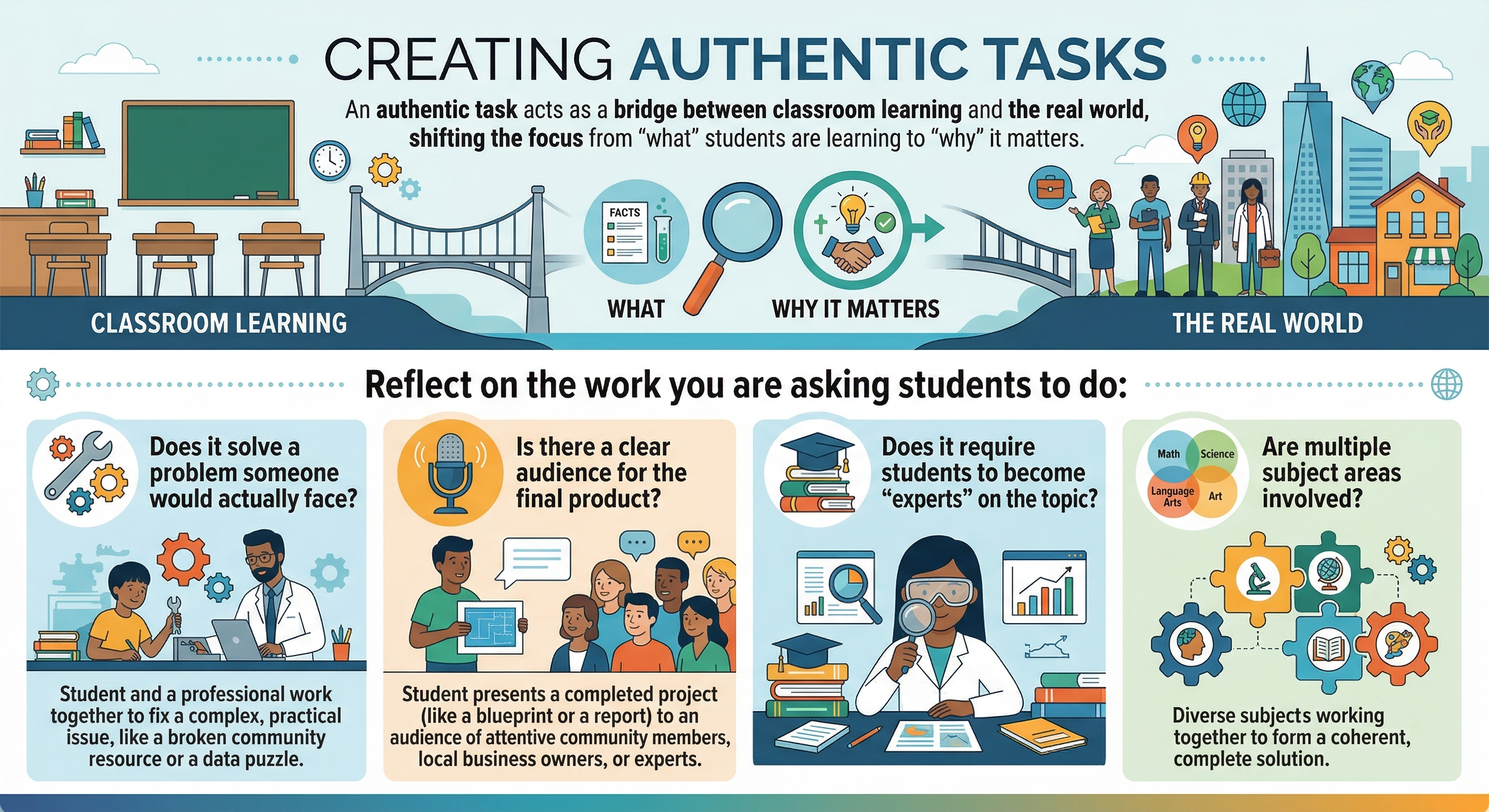
Authentic tasks create a bridge between what is learned in the classroom and why this knowledge is important to the world outside of the classroom. Authentic tasks are not meant to replace current classroom practice, but to provide another strategy to meet learning goals and measure student understanding.
What does an authentic task look like?
Consider immigration. An authentic task that addresses the essential question – “What factors contribute to successful relocation of new immigrants?” – should require students to apply their knowledge about past immigrants and the immigration process to solve a problem. For example:
Immigration Station
In the past four years, your city has had an influx of over 10,000 immigrants. Some of them have found work and are settling in, while others are having problems with assimilation and cultural differences. Due to your vast expertise on immigration, the mayor has asked you to join a newly-formed task force for successful immigrant relocation. Before the next budget is formed, the task force must devise a plan that will help these new immigrants relocate successfully in your city. Your plan might address housing, education, language barriers, cultural pride, job training, and health care.
Your task force will make a 15 minute presentation of what needs to be done. You should also have a list of expenses and a budget for implementing your plan.
Writing an authentic task is not an easy process, and your first few may be time consuming. You might choose to begin by looking on the Web and asking other teachers for samples. It is much easier to create authentic tasks once you have seen many examples.
When you are ready to write on your own authentic tasks, consider these ideas and questions.
Authentic or Real-World
The authentic, or real-world, nature of the task frames student work in a relevant and interesting way. The world of work provides many contexts for authentic tasks, but real-world connections can also be daily activities such as buying a house, determining nutritious meals for a family, and hosting a family celebration.
By requiring students to solve a real-world problem, an authentic task creates a bridge between the content learned in the classroom and why this knowledge is important in the world outside of it. Much of what we ask students to complete in the classroom is contrived. Life in the real world doesn’t usually ask you to choose from provided options A, B, C, or D.
An authentic task can help you make classroom work relevant to students by asking them to make these real-world decisions.
Consider these questions to help you give the task real-world relevance:
- Who might be faced with a problem that requires this knowledge?
- Where might they work?
- How would knowing this information affect a person’s life or work?
Products
An authentic task should include the creation of some sort of product. Again, rarely in the world of work does an employee create something for no reason at all or complete a worksheet that someone else will never utilize.
What kind of product should students make? As you are exploring a task, think about a person in the real world who would complete this task. Where would they work? What would they make? The definition of a “product” is quite broad. For example:
- A lawyer makes an argument.
- A politician creates a position paper.
- A graphic designer creates an ad campaign.
- An environmental scientist helps to create policy.
- A dancer completes a performance.
- A director puts together a movie.
The creation of a product also provides students with an opportunity to demonstrate their learning. Because of this, you will need to make sure that the product created will demonstrate mastery of the topic and understanding of key concepts.
- What kind of product can students create to address this problem or situation?
- Who is the audience for this product?
- What value does this product have?
Interdisciplinary Study
Authentic tasks, by definition, involve study from a variety of different disciplines. The essential question helps to facilitate this by both requiring inquiry and work from within many different disciplines, and also by linking disciplines and blurring the lines between them.
As students work to answer the essential question, they draw from their experiences in a variety of disciplines and stretch their knowledge and understanding of many subjects. Students also benefit from connecting to learning that goes beyond the traditional walls of the school building. The world literally becomes the students’ learning space.
- What different subject areas are involved?
- Can we work with a different subject area teacher?
Collaboration
Working in collaborative, heterogeneous teams prepares students for modern citizenship and work, as most complex communal, social, and workplace problems are solved by groups of individuals. Working in teams on complex problems requires skills and expertise, helping students identify their own strengths and weaknesses, and driving them to achieve their team goals.
- Can we collaborate in this classroom?
- Can we collaborate with another classroom?
Self-Direction
We often tell students what we want them to know; however, we often do not tell them why. Students’ involvement in their schoolwork increases significantly when they are taught why they are learning, and how these concepts can be used outside the classroom. Questioning how a classroom activity is relevant to the students who will be completing it is the first step on the long journey of developing a student-centered learning environment.
In answering the project’s essential question, students will be probing concepts and ideas in great detail and will not all be studying the exact same topic at the same time. A student-centered learning environment requires students to determine what and how information is learned. This improves their self-assessment skills, responsibility, and meta-cognition (learning how they learn). An authentic task also requires students to be responsible for locating the information and finding the answer on their own, with you as a resource or “guide on the side”.

Students, whether exploring on their own or in a group, are likely to investigate and study beyond the knowledge of their teacher. In this case, the teacher and students learn simultaneously and the students may enjoy the role of teaching their teacher. This, combined with the use of technology, creates an environment where it is impossible for the teacher to be the “sage on the stage”.
- Does the task allow students to choose the type of product they want to make?
- Does the task require students to become experts on the topic?
Reviewing Your Task
It may be impossible to include all of these recommendations for every task, but keeping them in mind will help maximize learning during the project. As your students complete your task, there will be many opportunities for discussion. Use these to help you expand the scope and make next year’s project even better!

Melinda Kolk is the Editor of Creative Educator and the author of Teaching with Clay Animation. She has been helping educators implement project-based learning and creative technologies like clay animation into classroom teaching and learning for the past 15 years.


 Most Read